When AI Outgrows the Planet
AI’s constraint is no longer algorithms or capital, but physical infrastructure. Power, cooling, land, and permitting are hard limits. This piece examines why orbital compute has crossed from theory into deployable reality, and what that means for the future of AI infrastructure.

Executive Takeaway
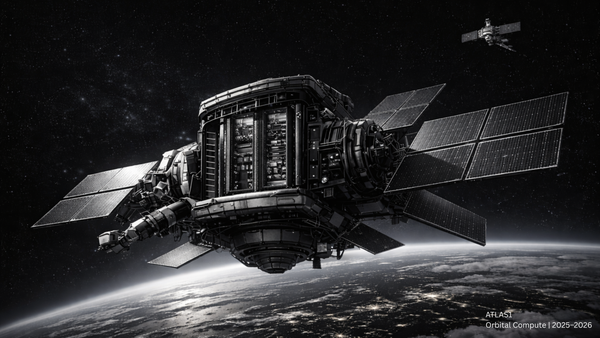
AI’s constraint is no longer algorithms or capital. It is where computation can physically live at scale. Over the past few days, orbital compute crossed a critical threshold: modern AI hardware has now been operated in orbit, serious system architectures for space-based AI have been published, and incumbent launch providers are quietly building data-centre-class capabilities beyond Earth. This does not mean AI is “moving to space”. It means the planet is becoming a binding constraint, and the alternative is no longer theoretical.
Signal
In isolation, recent developments are easy to dismiss.
- A modern AI accelerator running in orbit.
- A research paper outlining solar-powered AI satellites.
- Reporting that a launch provider has been developing orbital data-centre technology internally.
None of these are decisive on their own. What matters is alignment across three layers:
- Hardware maturity: contemporary, data-centre-class AI silicon functioning beyond Earth.
- Systems design: credible architectures that integrate power, compute, networking, and operations into something that can be scaled.
- Institutional intent: actors with the capital, launch access, and patience to build infrastructure rather than demos.
Infrastructure shifts do not announce themselves with a single breakthrough. They begin when these layers quietly converge. That is what just happened, and it rarely reverses.
Meaning
The dominant narrative is that AI is constrained by chips. That is already outdated. The harder constraints are now physical and political:
- Power generation that cannot be expanded quickly enough
- Cooling systems that compete for water and public tolerance
- Land, permitting, and grid interconnection timelines measured in years
- Increasingly localised opposition to hyperscale builds
These are not engineering optimisation problems. They are hard ceilings. Even if every GPU were available tomorrow, the world cannot site, power, and cool enough data centres fast enough to meet projected demand. This is the context in which orbital compute stops sounding exotic and starts sounding pragmatic.
Why Terrestrial AI Infrastructure Is Hitting Hard Limits
What is often missed in discussions about AI infrastructure is that today’s constraints are not additive. They are multiplicative. Power, cooling, land, permitting, and grid interconnection are not independent variables. Each one compounds the others, and failure at any point delays the entire system. Power is the first bottleneck. Large-scale AI workloads require continuous, high-density energy delivery. Adding generation capacity is not enough. That power must be transmitted, stabilised, and integrated into local grids that were never designed for sustained, hyperscale loads. Even where generation exists, grid interconnection queues now stretch multiple years in key markets. Cooling is the second bottleneck, and it is increasingly political. High-performance AI systems convert most of their input energy into heat. At scale, rejecting that heat requires either vast quantities of water or large physical footprints. Both are becoming contested. In many regions, water usage alone is now enough to halt or delay data-centre expansion, regardless of capital availability. Land and permitting form the third bottleneck. Hyperscale facilities are no longer invisible. They compete with housing, agriculture, and industry, and they attract local opposition. Environmental review, zoning, and permitting timelines have lengthened materially, even in jurisdictions previously considered friendly to infrastructure. Critically, these constraints interact. A site with available land may lack grid capacity. A site with power may face water restrictions. A site that solves both may be delayed by permitting. Solving one constraint without solving the others produces no usable capacity. This is why the current AI infrastructure challenge cannot be solved by incremental optimisation. More efficient chips help, but they do not eliminate the need for power. Better cooling techniques help, but they do not remove water and land constraints. Faster construction helps, but it does not compress regulatory timelines. The result is a growing mismatch between AI demand curves, which compound rapidly, and infrastructure deployment curves, which remain linear at best. This mismatch is not theoretical. It is already visible in delayed projects, constrained expansion plans, and rising competition for viable sites. Once demand outpaces the system’s ability to absorb it, alternatives that were previously dismissed as “too complex” or “too early” begin to look rational. That is the context in which orbital compute enters the conversation.
Strategic Impact
Orbit does not make compute cheap. What it does is rearrange constraints. Certain orbital regimes offer near-continuous solar exposure. Thermal rejection no longer competes with freshwater or urban tolerance. Capacity can be added without negotiating with local grids or municipalities. But new costs appear:
- launch and deployment
- radiation tolerance and fault rates
- replacement cadence
- debris and regulatory constraints
The key insight is this:
Orbital compute is not superior in every dimension.
It is superior in the dimensions Earth is now failing at.
That asymmetry is what creates an infrastructure opening.
Why This Forces a Strategic Rethink Now
For serious AI operators, the question is no longer “does this work”. It is whether waiting creates exposure that cannot be unwound later. It is:
Where are our expansion plans brittle? What happens if marginal capacity becomes unavailable faster than expected? Which workloads cannot tolerate local grid or regulatory exposure?
Orbital compute enters the picture as a pressure valve, not a replacement. It selectively absorbs workloads and capacity that terrestrial infrastructure struggles to accommodate.
- Constrained geographies
- Sovereign and defence workloads
- Energy-bound or latency-tolerant compute
- Future capacity that cannot wait for terrestrial approval cycles
This reframes the competitive landscape. Launch access becomes strategic infrastructure. Systems integration becomes the moat. The value shifts away from software abstractions and toward power, thermal, networking, and reliability engineering. AI, once again, becomes an infrastructure problem.
Where the Real Opportunity Sits
The obvious play is to talk about “orbital clouds”. That is not where the leverage is. The real opportunity is in standardisation:
- repeatable compute modules
- predictable power and thermal envelopes
- known failure and replacement economics
- verifiable uptime under orbital conditions
The first wins will be quiet. They will look boring. They will sit underneath louder narratives. Inference and batch workloads come first. Frontier training may follow, or it may not. Either way, the firms that matter will be the ones that make orbital compute financeable, not just functional.
Signals That Actually Matter
Ignore announcements. Watch for:
- disclosed duty cycles across repeated runs
- multi-node operations with stable optical links
- standardised designs rather than bespoke satellites
- early anchoring by sovereign or defence customers
These are the tells of infrastructure formation, and they tend to appear before markets reprice.
What This Is Grounded In
This view is informed by a combination of:
- recently published system architectures for solar-powered, space-based compute
- disclosed on-orbit operation of modern AI accelerators
- public reporting on launch providers developing orbital data centre capabilities
- current grid, water, and permitting constraints affecting hyperscale deployments
We are deliberately not overfitting to any single announcement. Infrastructure shifts reveal themselves through pattern alignment, not press releases.
Final Clarity
AI did not suddenly “go to space”. Earth simply stopped being sufficient on its own. When that happens in infrastructure, the alternative does not need to be perfect. It only needs to be possible soon enough. That is the inflection point we are now entering.
Atlas1 publishes independent intelligence on frontier compute and infrastructure shaping the next compute era.