2025: The Year AI Escaped Earth’s Gravity
2025 was the year AI collided with Earth’s limits. Power queues stretched into years, cooling and land became binding constraints, and time-to-deployment overtook capital. This piece examines how those pressures pushed compute off-planet, and what capital should watch next.

For most of the past decade, artificial intelligence advanced along a familiar axis: faster chips, larger models, denser data centres.
In 2025, that trajectory finally collided with a harder constraint. Not silicon. Not algorithms.
Power, land, cooling, and time.
As AI demand accelerated, terrestrial infrastructure failed to keep pace. Grid interconnection queues stretched into years. Water availability tightened. Permitting timelines ballooned. In key regions, new data centres were delayed not by capital or ambition, but by physics and bureaucracy. That collision forced a question that had long been theoretical to become practical:
If Earth cannot scale fast enough, where does compute go next?
In 2025, the answer began to take shape. Not in a single breakthrough, but through a series of converging signals that all pointed upward. This was the year orbital computing stopped being speculative and started becoming allocatable.
The Constraint That Changed Everything: Time-to-Power
AI now scales on months, not decades. Infrastructure does not.
Across the U.S. and Europe, grid upgrades routinely face four-to-seven-year delays. Cooling constraints increasingly compete with municipal water needs. Land availability near transmission nodes is finite. Even when capital is abundant, time-to-power has become the binding variable. Once delay itself carries an opportunity cost measured in lost model generations, the geography of compute stops being sentimental. What matters is not where infrastructure is located, but how quickly energy can be delivered at scale. That reframing is what made space economically interesting again.
Starcloud and the Proof-Point Moment
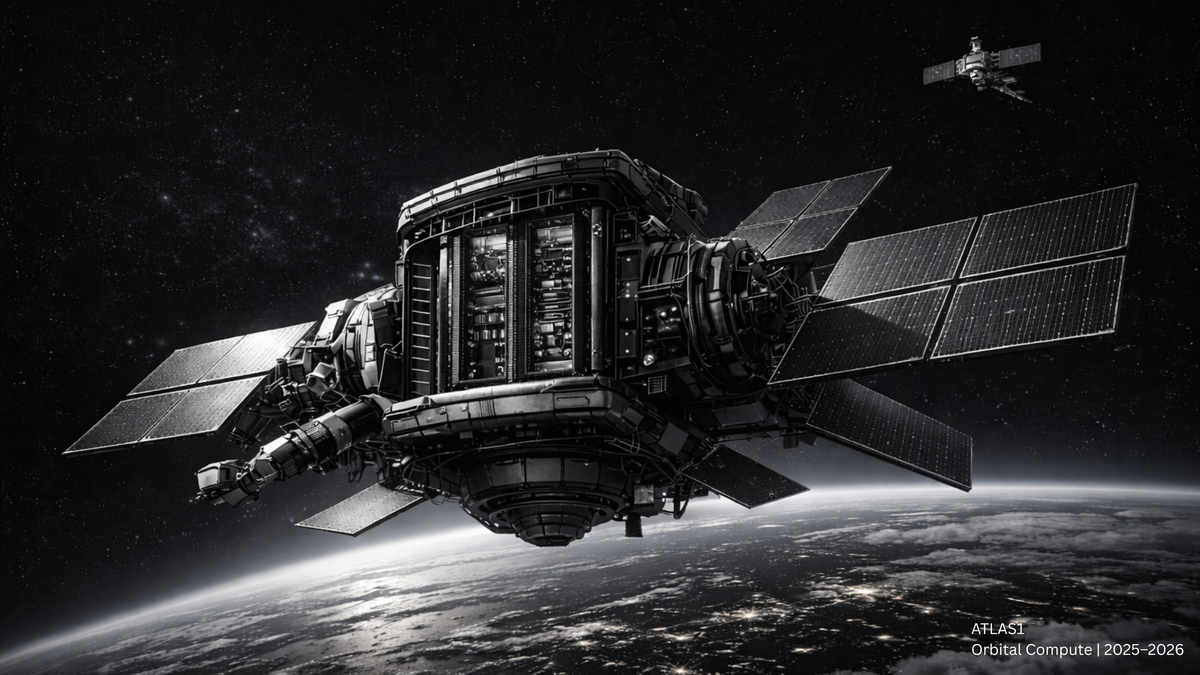
In late 2025, a quiet but important milestone landed in orbit. Starcloud launched a satellite equipped with an Nvidia H100 GPU and successfully trained a small language model entirely in space. The demonstration was modest in scale, but decisive in implication.
It validated three first-principles advantages that are effectively impossible to replicate on Earth:
- Continuous solar exposure at roughly 1.3 kW/m², without night cycles or weather variability
- Vacuum-based radiative cooling, eliminating the need for water or energy-intensive chillers
- Isolation from terrestrial permitting and grid queues, dramatically compressing deployment timelines
This was not about outperforming terrestrial data centres today. It was about proving that compute could exist outside Earth’s bottlenecks altogether. Once that door opened, capital began to look through it.
Sovereign Capital Enters the Stack: Hungary and Axiom
One of the most revealing moves of the year did not come from Silicon Valley. In December, Hungary’s 4iG committed $100 million to Axiom Space, a commercial station developer building post-ISS orbital platforms. The investment was phased, patient, and explicitly infrastructure-oriented. This was not venture capital chasing optionality. It was sovereign-aligned capital underwriting long-duration orbital assets.
The logic is straightforward: Sustained on-orbit compute, data processing, and station-based services cannot scale on venture timelines alone. They require capital that tolerates long build cycles, geopolitical complexity, and strategic rather than purely financial returns.
Hungary’s move signalled something larger: smaller nations are using space infrastructure to bypass terrestrial disadvantages and secure relevance in the AI era. That dynamic will not be unique.
Hyperscalers Follow the Energy, Not the Map
While startups proved feasibility and sovereigns provided ballast, hyperscalers quietly adjusted their posture.
In 2025, Alphabet’s acquisition of Intersect Power underscored a broader trend: vertical integration into energy is no longer optional. When grid access becomes the rate-limiter, ownership beats contracts.
At the same time, research efforts explored hybrid Earth-orbit architectures, using space-based nodes for preprocessing, redundancy, and energy-intensive workloads that strain terrestrial systems. The direction was clear. When infrastructure friction rises, compute architectures diversify. Orbit is not a replacement for Earth. It is an overflow valve.
SpaceX and the Economics of Scale
No discussion of orbital infrastructure is complete without SpaceX.
By the end of 2025, the company had openly discussed upgrading satellite platforms to host meaningful compute workloads, powered by onboard solar arrays and linked via laser interconnects. The economics are uniquely theirs:
- Launch cost compression
- Rapid iteration cycles
- Vertical integration across launch, satellites, and connectivity
Whether or not SpaceX executes every element of its vision, the implication matters: launch cadence is collapsing as a barrier. Once mass-to-orbit is cheap and frequent enough, orbital infrastructure stops being exotic and starts behaving like a new industrial zone.
China’s Parallel Path: Sovereign Compute at Scale
While Western efforts focused on modularity and commercialisation, China pursued scale.
In 2025, it began deploying the first elements of an AI-enabled satellite constellation designed to perform significant processing in orbit. The objective was explicit: reduce reliance on terrestrial bottlenecks, lower latency for sensing and analytics, and build sovereign compute capacity beyond Earth. This approach mirrors China’s broader infrastructure strategy. Where the West negotiates, China builds. The result is a widening divergence in how quickly different systems can adapt when physical constraints tighten.
From Curiosity to Capital Class
By the end of 2025, orbital data centres were no longer a novelty category. Market projections began to reflect that shift, with long-term forecasts moving from niche applications toward tens of billions in potential value over the next decade. But the more important change was conceptual. Compute stopped being assumed to be terrestrial by default. Once that assumption breaks, a cascade follows:
- Energy moats replace land moats
- Time-to-deployment outweighs marginal efficiency
- Sovereign alignment becomes a feature, not a risk
These are the conditions under which entirely new infrastructure classes form.
What Capital Is Really Pricing (And What It Isn’t Yet)
For capital allocators, the orbital compute story is often misunderstood as a technology question. It is not.
It is a timing, capital-structure, and energy-access question.
The near-term advantage of orbital compute is not lower unit cost. It is faster delivery of usable capacity in a world where terrestrial power upgrades take years. In markets where AI model generations are measured in months, delay itself becomes a financial liability.
The first profitable orbital compute deployments will not look like general-purpose cloud. They will be contracted, sovereign-adjacent, and focused on workloads where uptime, independence, and speed outweigh marginal cost.
This is why sovereign capital is entering early, and why hyperscalers are vertically integrating into energy. Venture capital alone cannot finance assets that take years to build and decades to matter.
The real bottleneck is not physics. It is financing structures and regulatory timing.
By the time orbital compute feels obvious, the excess returns will already have been earned by those who treated it as infrastructure before it was fashionable to do so.
What 2026 Will Decide
The coming years will not be defined by whether orbital compute works. That question has already been answered.
They will be defined by:
- How quickly launch costs continue to fall
- Whether regulatory frameworks adapt to hybrid architectures
- Which nations treat orbital infrastructure as strategic, not symbolic
- How capital prices time and reliability versus geography
By 2026, early orbital platforms will not replace Earth-based data centres. But they will do something more important. They will prove that AI no longer needs to live where power is scarce, slow, or contested. That is not a science-fiction milestone. It is an infrastructure one. And once infrastructure moves, capital follows.